Self care journals for mindfulness range from heavy-handed structured planners to open-ended diaries, and the right one depends on how much guidance you actually want each day. The Five Minute Journal earns my best overall pick because its minimal morning-and-evening format is the easiest habit to sustain, which is the single biggest factor in whether a mindfulness journal works. If you want something deeper, INSIDE THEN OUT Dig Deeper offers 180 undated prompts that push past surface-level gratitude, and Yop & Tom Wellness Journal splits its pages across body, mind, and soul for a more rounded routine. The main tradeoff you’ll face is structure versus flexibility: highly guided journals keep beginners on track but can feel repetitive, while freer formats grow with you but demand more initiative. Read on for the full breakdown of all 15.

Get the little things that make your day delivered free — and shop member deals
- Fast, free delivery on millions of items
- Access to Prime Big Deal Days deals on October 6–7
- Prime Video, Amazon Music and more included
Key Takeaways
- Time commitment was the biggest differentiator: The Five Minute Journal and Self-Care: A Day and Night Reflection Journal won on sustainability because they ask for minutes, not pages, while FINDING BALANCE and the 13-Week Guided Journal demand more daily effort but deliver deeper reflection.
- Dated versus undated formats split the lineup — undated options like INSIDE THEN OUT and the And Per Se Wellness Journal forgive missed days, which matters more for habit-building than most buyers expect.
- The sweary sub-category (Let That Sh*t Go and Fuck It) works well for readers who find traditional gratitude language off-putting, but both trade polish and structure for attitude.
- The UNCLE EJ reusable journal stands alone as the only wipe-clean option, making it the lowest long-term cost but the weakest keepsake, since nothing you write is preserved.
- A5 hardcovers dominated the mid-range for portability and durability, while the Switch Research A4 journal is the only true desk-format option — better for long-form writing, worse for bedside or travel use.




| self care journals for mindfulness | Format |
|---|---|
| Gratitude & Self-Care Journal | — |
| Yop & Tom Wellness Journal | Hardcover |
| FINDING BALANCE Mental Health | — |
| A Year of Self-Care Journal: 5 | Guided journal |
| And Per Se Wellness Journal | Undated daily journal |
| Self-Care: A Day and Night Ref | Day and night reflection journal |
| INSIDE THEN OUT Dig Deeper Jou | — |
| Let That Sh*t Go: A Journal fo | — |
| Undated 6-Month Gratitude Jour | A5; 5 x 8 inches |
| The Five Minute Journal: Undat | — |
| Switch Research Self-Love Jour | A4 guided writing notebook |
| Do It For Yourself: A Motivati | Paperback |
| Fuck It: A Guided Self-Love an | Journal (paperback) |
| 13-Week Guided Mindfulness Jou | — |
| UNCLE EJ Reusable Guided Affir | Reusable workbook kit, 2 grooved journals |
More Details on Our Top Picks
Gratitude & Self-Care Journal – Guided Mindfulness Journal with Prompts, A5, Brown
This option stands out for pulling together gratitude, self-love, and reflection prompts in a single daily format without feeling cluttered. Where The Five Minute Journal keeps entries brief and minimal, this one adds an evening reflection section and a weekly habit tracker, which gives readers a fuller mindfulness loop across the whole week. The vegan leather hardcover and 120 GSM paper put it a step above the Yop & Tom’s paper cover in terms of durability, and the undated structure means a missed week doesn’t leave blank-page guilt. The tradeoff is the six-month runway: compared with A Year of Self-Care Journal, you’ll be repurchasing twice as often. And the plain ruling suits sketchers and free-writers but frustrates anyone who wants neat lined entries.
Pros:- Combines gratitude, affirmation, and reflection prompts in one daily spread
- Weekly habit tracker adds accountability most gratitude journals skip
- Durable vegan leather hardcover with thick 120 GSM paper
- Undated format lets you start anytime and skip days guilt-free
Cons:- Six-month duration means buying a replacement fairly quickly
- Plain ruling doesn’t suit people who prefer structured lined pages
Best for: Journalers who want one durable book covering gratitude, reflection, and habit tracking without managing multiple notebooks
Not ideal for: People who want a lined, tightly structured layout or a journal that lasts a full year without repurchasing
- Brand:Productivity Store
- Size:A5
- Color:Brown
- Duration:Undated, 6 months
- Cover Material:Vegan leather
- Paper Weight:120 GSM
- Binding:Hardcover
- Ruling Type:Plain
Our verdict“The most balanced pick for daily mindfulness practice if you want durability and structure in one book and don’t mind restocking every six months.”
Yop & Tom Wellness Journal – Self Care Journal & Mindfulness Diary, 192 Pages Hardcover, Body Mind Soul
Most journals in this roundup treat mindfulness as a mental exercise; the Yop & Tom treats it as a whole-body data project. Its daily pages track energy, stress, sleep, and exercise alongside intentions, so patterns between a bad night’s rest and a tense Tuesday become visible over weeks. Compared with the Gratitude & Self-Care Journal, which is more emotionally focused, this one suits analytical journalers who like numbers and trends. The weekly recaps give you a natural checkpoint that freer journals lack, and the bookmark ribbon is a small touch that daily users will appreciate. The weakness is material: a paper hardcover won’t survive a handbag the way vegan leather options do, and there’s no elastic closure to keep it shut.
Pros:- Tracks energy, stress, sleep, and exercise in a structured daily format
- Weekly recaps encourage reflection and course correction
- Bookmark ribbon keeps your place between sessions
- Body-mind-soul framing connects physical habits to mental wellbeing
Cons:- Paper cover material is less durable than leather alternatives in this lineup
- No elastic closure, so pages can bend in transit
Best for: Data-minded readers who want to connect sleep, stress, and exercise patterns to their mental state
Not ideal for: Anyone carrying their journal daily in a bag — the paper hardcover scuffs and wears faster than leather-bound rivals
- Brand:Yop & Tom
- Pages:192
- Cover Material:Paper
- Format:Hardcover
- Tracks:Energy, stress, sleep, exercise
- Extras:Weekly recaps, bookmark ribbon
Our verdict“The right pick if your mindfulness practice includes watching physical metrics, not just writing gratitudes.”
FINDING BALANCE Mental Health Journal – 6-Month Daily Guided Journal with Prompts, Beige Spiral
Of everything here, this is the journal most explicitly built around mental health structure: 26 reflective prompts, daily-to-monthly mood tracking, and a six-month review that ties it together. The prompts do real work for beginners — compared with Let That Sh*t Go, which leans on humor and attitude, FINDING BALANCE hands you a clinical-feeling framework that reduces the intimidation of a blank page. The guided audio meditation via QR code is a genuine differentiator no other pick offers. Its discreet unmarked cover with elastic closure makes it the best choice for anyone who values privacy at work or while traveling. Tradeoffs: the spiral binding is functional but bulkier and less elegant than the sewn hardcovers elsewhere, and the sand-beige look is muted rather than inspiring.
Pros:- 26 structured prompts remove the blank-page barrier for beginners
- Daily, weekly, and monthly mood and habit tracking reveals longer patterns
- Discreet unmarked cover with elastic closure protects privacy
- Free guided audio meditation via QR code adds a non-writing mindfulness tool
Cons:- Fixed six-month timeframe with no skipping ahead or extending
- Spiral binding is bulkier and less durable long-term than sewn hardcovers
Best for: People working on anxiety or low mood who want guided prompts, mood tracking, and privacy in one place
Not ideal for: Anyone wanting a sleek coffee-table journal — the spiral binding and muted beige finish read as functional, not decorative
- Duration:6 months
- Number of Prompts:26 structured prompts
- Cover:Faux leather hardcover, sand colored
- Binding:Spiral bound
- Closure:Elastic
- Tracking:Daily, weekly, and monthly habit/mood tracking
- Extras:Free guided audio meditation (QR code)
Our verdict“The strongest option if mental health support — not just gratitude — is the point of your practice.”
A Year of Self-Care Journal: 52 Weeks to Cultivate Positivity & Joy
In a lineup dominated by 90-day and 6-month formats, this is the only mainstream option built around a full 52-week arc. That changes the practice entirely: instead of resetting your intentions every quarter like you would with the And Per Se journal, you build one continuous thread of reflection across seasons, which suits people whose self-care goals are slow-moving. The positivity and joy focus makes it gentler than the FINDING BALANCE journal, which is oriented around mood management and mental health tracking. The weekly cadence also demands less than daily journals — a realistic middle ground for busy readers. The flip side is real: entries are less granular than daily formats, so it won’t capture sleep, mood, or habit data, and the lighter structure may leave detail-oriented journalers wanting more.
Pros:- Full year of structure without repurchasing midway
- Weekly cadence fits busy schedules better than daily journals
- Positivity-focused prompts keep the tone gentle and encouraging
- Long arc builds a meaningful record of a full year
Cons:- No daily tracking, so mood and habit patterns go unrecorded
- Lighter structure may feel thin compared with data-rich journals like the Yop & Tom
Best for: Readers who want a sustainable once-a-week reflection habit they can actually keep for twelve months
Not ideal for: Anyone seeking daily prompts or mood and habit tracking — the weekly format is too loose for granular self-monitoring
- Format:Guided journal
- Duration:52 weeks (1 year)
- Focus:Self-care, positivity, and joy
- Cadence:Weekly reflections
Our verdict“The pick for consistency over intensity — a year of low-pressure weekly reflection rather than daily data capture.”
And Per Se Wellness Journal – Self Care & Daily Journal for Women with Habit Tracker, Undated (Original Beige)
This is the most presentation-forward journal in the batch: gold foil stamping, gift-ready packaging, and a lay-flat 180° binding that makes daily writing genuinely more comfortable than standard hardcovers like the Gratitude & Self-Care Journal. Its daily page is the most comprehensive single layout here — gratitude, reflection, habits, goals, plus sleep, meals, water, exercise, and mood — effectively replacing a drawer of wellness apps. Compared with the Yop & Tom, it covers similar body-mind territory but with more premium materials and finer paper at 100gsm. The tradeoffs are real, though: the same daily template for 91 days can feel repetitive for freeform writers, and the quarterly duration means the cost of continuing adds up faster than a year-long option.
Pros:- Undated pages let you skip days without wasting entries
- All-in-one daily layout tracks sleep, meals, water, exercise, and mood
- Lay-flat 180° binding makes writing more comfortable
- Gift-ready packaging with gold foil detailing
Cons:- Repetitive daily prompts may bore freeform writers over time
- 91-day duration means frequent repurchasing to sustain the habit
Best for: Anyone buying a beautiful, ready-to-gift wellness journal — or detail lovers who want every daily metric on one page
Not ideal for: Freeform journalers who find identical daily templates repetitive, or those wanting a format lasting beyond 91 days
- Format:Undated daily journal
- Duration:91 days
- Cover:Hardcover with gold foil stamping
- Binding:Lay-flat (180°)
- Paper:100gsm premium paper
- Color:Original Beige
- Tracks:Gratitude, habits, goals, sleep, meals, water, exercise, mood
Our verdict“The best-looking, most complete daily tracker here — ideal as a gift or for app-fatigued self-quantifiers, less so for spontaneous writers.”
Self-Care: A Day and Night Reflection Journal (Inner World)
Day-and-night reflection gives this journal a clear place in a mindfulness routine: readers can use it to check in at the start and end of the day. That two-part focus sets it apart from The Five Minute Journal, which is framed around brief daily prompts, and from the six-theme exploration in INSIDE THEN OUT Dig Deeper Journal. The format could suit someone who wants self-care to bookend everyday life rather than follow a long themed sequence. The available product information is sparse, though: it does not specify the prompts, page count, paper, binding, or whether the journal is dated. I would choose it for the day-and-night concept, while readers who need clear details about structure or materials may be better served by the more fully specified alternatives.
Pros:- Day-and-night reflection gives a daily self-care routine a clear structure
- Focuses on self-care rather than a single gratitude or goal-setting theme
- The format can support both a morning intention and an evening check-in
Cons:- Prompt details and the journal’s interior structure are not provided
- No specifications are available for paper, binding, size, or page count
- The two-part daily format may feel repetitive to people who prefer varied prompts
Best for: Mindfulness beginners who want a journal centered on checking in once in the morning and once at night
Not ideal for: Buyers who need confirmed details about prompt content, page count, paper quality, or dated versus undated use
- Title:Self-Care: A Day and Night Reflection Journal (Inner World)
- Format:Day and night reflection journal
- Subject:Self-care
- Prompt details:Not provided
- Page count:Not provided
- Binding:Not provided
Our verdict“Choose this for a simple morning-and-evening self-care framework if the limited product details are acceptable.”
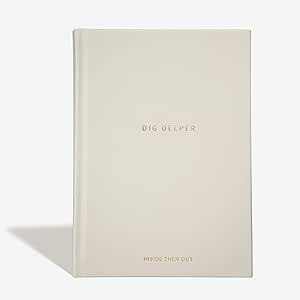
INSIDE THEN OUT Dig Deeper Journal – Guided Daily Journal with 180 Undated Prompts
Six themes and 180 undated prompts give this journal more direction than the open-ended day-and-night concept of Self-Care: A Day and Night Reflection Journal. Intention, healing, gratitude, presence, purpose, and growth let readers focus on different parts of wellbeing without committing to a dated schedule. Its lay-flat binding and 100gsm paper also make writing across the page more comfortable, with paper described as bleed-proof. Compared with The Five Minute Journal, this is better suited to people who want to explore several self-care themes, rather than keep to a brief daily format. The tradeoff is the same structure that helps hesitant writers: a prompt-led approach can feel restrictive if you prefer free-form pages, and its A5 hardcover is less portable than a small notebook.
Pros:- 180 undated prompts allow readers to start, pause, and resume at their own pace
- Six themes offer more varied reflection than a single-focus gratitude journal
- Lay-flat binding supports comfortable writing across the page
- 100gsm paper is described as bleed-proof
Cons:- The prompt structure may limit writers who prefer blank pages
- The hardcover weighs 1.15 pounds, which may feel heavy for everyday carry
Best for: Prompt-seeking journalers who want flexible pacing and guided exploration across several mindfulness and personal-growth themes
Not ideal for: Free-form writers or people seeking a lightweight journal to carry everywhere
- Brand:INSIDE THEN OUT
- Pages:187
- Prompts:180 undated prompts
- Themes:Intention, healing, gratitude, presence, purpose, and growth
- Size:5.8 x 8.5 inches (A5)
- Paper:100gsm ruled paper, described as bleed-proof
- Cover and binding:Textured vegan leather with gold details; lay-flat binding
- Weight:1.15 pounds
- Bookmark:Ribbon bookmark
Our verdict“Pick this if you want a substantial, flexible journal with prompts across multiple areas of self-care.”
Let That Sh*t Go: A Journal for Leaving Your Bullsh*t Behind and Creating a Happy Life
Direct, irreverent framing gives this journal a different emotional tone from the gentler routine-building focus of The Five Minute Journal. Its stated aim is to help readers reflect, process emotions, and move toward a happier mindset, which may appeal when conventional gratitude prompts feel too polite or restrained. That makes it a more specific choice than INSIDE THEN OUT Dig Deeper Journal, whose six themes span a broader range of self-reflection. The available description does not detail the exercises, page layout, length, or materials, so I cannot judge how much room it gives for mindfulness practice or whether its guidance is structured. The strong language is part of its candid identity, but it may not suit readers who want a calm, neutral journal or a gift for someone whose tastes are uncertain.
Pros:- Centers emotional reflection and release rather than only gratitude tracking
- Direct tone may resonate with readers who find softer self-help language unconvincing
- Connects reflection with the stated goal of building a happier mindset
Cons:- Strong language will not suit every reader or gifting situation
- Prompt content and the amount of writing space are not specified
- Paper, binding, dimensions, and page count are not provided
Best for: Adults who welcome blunt language and want a guided outlet for reflecting on negativity and personal growth
Not ideal for: Readers seeking a gentle mindfulness tone, detailed product specifications, or a journal suitable for a broad audience
- Product type:Journal
- Subject:Self-help and personal growth
- Stated focus:Emotional reflection, release, and personal growth
- Tone:Candid, strong language
- Prompt details:Not provided
- Page count:Not provided
Our verdict“Choose it for a candid emotional-reflection approach if its language and limited product details fit your preferences.”
Undated 6-Month Gratitude Journal with Prompts, A5, Brown
Gratitude, affirmations, goals, evening reflection, and mood tracking make this the broadest daily check-in among the five picks. That mix can help someone connect mindful attention with practical self-observation, while its undated format allows breaks without making the pages feel out of sequence. Compared with the more exploratory INSIDE THEN OUT Dig Deeper Journal, this journal appears oriented toward a repeatable daily routine; it offers several check-in types rather than six distinct reflection themes. The 120gsm paper is heavier than the specified paper in that journal, though the product data does not state that it is bleed-proof. Its six-month design gives the routine a defined span, which may help with commitment but is less suitable for someone who wants an open-ended notebook.
Pros:- Combines gratitude, affirmations, goal setting, and evening reflection
- Mood tracker adds a way to notice emotional patterns over time
- Undated pages allow starting or pausing without losing calendar alignment
- 120gsm paper is a substantial specified paper weight
Cons:- The six-month format gives the journal a defined use period
- The daily mix of trackers and prompts may feel busy to free-form writers
- Paper is not described as bleed-proof despite its stated weight
Best for: Routine-minded journalers who want gratitude, mood, affirmation, goal, and evening prompts in one daily format
Not ideal for: People who want an indefinite journal, mostly blank pages, or a compact pocket-sized notebook
- Brand:Productivity Store
- Format:A5; 5 x 8 inches
- Duration:Six months
- Paper:120gsm
- Cover:Brown hardcover
- Ruling:Plain
- Included features:Gratitude, affirmations, goal setting, evening reflection, quotes, and mood tracker
- Unit count:1
Our verdict“Choose this for a structured six-month routine that combines gratitude with mood and goal check-ins.”
The Five Minute Journal: Undated Guided Gratitude Journal
Brief daily prompts make this the most approachable choice here for someone who wants mindfulness to fit into a few minutes. Its gratitude and reflection focus is narrower than the mix of mood tracking, goals, and evening prompts in the Undated 6-Month Gratitude Journal, which may be a benefit if a busier routine feels like work. The undated pages also let readers restart after a missed day without having to catch up. A linen hardcover and sustainably sourced paper add material details absent from the description for Self-Care: A Day and Night Reflection Journal. The tradeoff is repetition: a short daily structure supports habit-building, but people who want deeper, varied exercises or room for long entries may find it too constrained. The product description also emphasizes consistency, so the routine suits regular check-ins best.
Pros:- Short guided prompts make a daily practice easier to fit into a busy routine
- Undated pages accommodate missed days and flexible starts
- Gratitude and reflection provide a focused entry point for mindfulness
- Linen hardcover and sustainably sourced paper are specified
Cons:- A brief daily format may not leave enough room for deeper reflection
- The gratitude-led structure is narrower than journals with mood tracking or multiple themes
- The described habit-building approach may feel repetitive to occasional journalers
Best for: Beginners and busy adults who want a guided gratitude check-in that takes about five minutes
Not ideal for: Writers who want long-form emotional processing, varied thematic exercises, or extensive blank space
- Brand:Intelligent Change
- Journal type:Guided gratitude journal
- Page format:Undated
- Daily time:About five minutes
- Binding:Linen hardcover
- Paper:Sustainably sourced
- Weight:309 g
- Unit count:1
Our verdict“Pick this for a focused, low-effort gratitude routine if you prefer short entries to extended self-reflection.”
Switch Research Self-Love Journal for Women – Guided Mindfulness, Gratitude & Self-Reflection Notebook (A4)
This option stands out for the depth of its 13-week therapist-informed curriculum. Where the 13-Week Guided Mindfulness Journal asks for short daily check-ins, this one builds a progressive program — new weekly themes layer mindfulness exercises onto gratitude and self-reflection so the practice develops rather than repeats. The bonus video content and private community are the real differentiators; no other journal in this roundup offers accountability beyond the page, which matters if solo journaling tends to fizzle out by week three. The tradeoff is commitment: a 91-day program with larger A4 pages demands more desk space and consistency than a slim pick like The Five Minute Journal. Compared with Do It For Yourself, it trades motivational pep for evidence-based structure, which suits buyers who want a curriculum, not a pep talk.
Pros:- Progressive 13-week curriculum with fresh weekly themes
- Therapist-recommended, evidence-based prompts
- Bonus videos and a private community add accountability
- Premium paper and attractive A4 design
Cons:- 91-day commitment can feel demanding and hard to sustain
- Large A4 format is less portable than A5 alternatives
Best for: Women who want a long-term, therapist-style structured program and benefit from community accountability
Not ideal for: Casual or time-strapped journalers — a 91-day, multi-part daily practice is a real commitment, and the A4 size is not portable
- Format:A4 guided writing notebook
- Duration:91 days / 13 weeks
- Focus:Self-love, mindfulness, gratitude, personal growth
- Includes:Guided prompts, instructional videos, private community access
- Recommended By:Therapists
- Audience:Women
Our verdict“This pick makes the most sense for women ready to commit to a full guided transformation with support beyond the page, not a casual dip into journaling.”
Do It For Yourself: A Motivational Journal (Start Before You’re Ready Guided Journal)
Most journals in this roundup look inward; this one pushes you outward. Its prompts are built around action and momentum — the “start before you’re ready” framing targets procrastination and perfectionism rather than quiet reflection. Compared with the Switch Research Self-Love Journal, it skips the weekly curriculum and clinical scaffolding entirely, which is either its greatest strength or its weakness depending on what you need. Buyers who found structured programs like Finding Balance too rigid will appreciate the lighter, momentum-driven approach; buyers seeking genuine mindfulness practice — breathing exercises, gratitude rituals, present-moment work — should look elsewhere, because that is not the core mission here. It also lacks the physical extras of the 13-Week Guided Mindfulness Journal, such as bookmarks or a keepsake box, keeping it a simple paperback.
Pros:- Prompts specifically target procrastination and perfectionism
- Low-pressure, flexible format without rigid daily requirements
- Encourages action alongside self-reflection
- Simple paperback format is affordable and giftable
Cons:- Loose structure may leave beginners without direction
- Light on traditional mindfulness and gratitude content compared with dedicated journals in this guide
Best for: Buyers stuck in overthinking who want short prompts that push action and self-motivation
Not ideal for: Anyone seeking a true mindfulness practice with breathing, gratitude rituals, or structured reflection — this is motivation-first, not meditation-first
- Type:Guided journal
- Format:Paperback
- Focus:Motivation, self-starting, personal growth
- Structure:Flexible guided prompts
- Audience:General
Our verdict“Choose this if your biggest obstacle to self-care is getting started — skip it if you want a structured mindfulness routine.”
Fuck It: A Guided Self-Love and Gratitude Journal for Women
Tone is the entire point here. Where journals like Let That Sh*t Go flirt with irreverence, this one leans fully into a humorous, no-nonsense voice aimed at women burned out on earnest self-help language. That tone lowers the barrier to entry: readers who abandoned the Switch Research journal because it felt like homework may actually stick with this one, because the prompts feel like a friend venting with you rather than a therapist assigning exercises. The focus on releasing negativity and self-acceptance keeps it genuinely useful beneath the swearing. The tradeoffs are real, though — the title makes it awkward for workplace or family gifting, and there is little public detail about page count or program length, so buyers comparing it feature-for-feature with the 13-Week Guided Mindfulness Journal are buying on voice rather than specs.
Pros:- Irreverent humor makes self-help approachable for skeptics
- Guided prompts suit complete beginners
- Centers on letting go of negativity and self-acceptance
- Lower emotional barrier than clinical-feeling alternatives
Cons:- Profanity limits gifting and audience fit
- Sparse published detail on structure, length, and features
Best for: Women who find traditional self-help journals preachy and want an irreverent, laugh-out-loud entry point to gratitude practice
Not ideal for: Gift-givers shopping for professional, family, or conservative recipients, and anyone who wants a detailed structured program with clear duration and features
- Format:Journal (paperback)
- Genre:Self-Help / Self-Care
- Focus:Self-love, gratitude, releasing negativity
- Tone:Humorous, irreverent
- Audience:Women
Our verdict“Buy it for yourself if serious self-help makes you cringe; pass if you need a gift-safe cover or a documented program.”
13-Week Guided Mindfulness Journal for Women
This is the roundup’s most complete physical package. The vegan leather A5 cover, 100gsm ivory paper, dual bookmarks, elastic closure, and inner pocket put it a tier above standard paperbacks like Do It For Yourself, and the keepsake gift box plus optional sets (brass pen, aventurine bracelet, candle) make it the strongest gifting play alongside the UNCLE EJ kit. Content-wise it splits the difference between competitors: more structured than Fuck It, less demanding than the 91-day Switch Research program, asking just 10–15 minutes daily across 13 weeks with varied readings, prompts, and gratitude practice. That balance is deliberate — enough guidance to build a real habit, not so much that it overwhelms. The drawbacks: it still requires a genuine daily time commitment, and the women-specific framing narrows its audience compared with neutral options like Inside Then Out.
Pros:- Premium vegan leather build with 100gsm ivory paper
- Practical extras: dual bookmarks, elastic closure, inner pocket
- Balanced mix of readings, prompts, gratitude, and exercises
- Keepsake gift box and optional ritual gift sets
Cons:- Requires consistent 10–15 minute daily practice
- Explicitly designed for women, limiting broader appeal
Best for: Buyers wanting a beautifully made, gift-ready mindfulness journal that balances daily structure with a manageable time commitment
Not ideal for: Men or buyers wanting a gender-neutral journal, and anyone unwilling to commit 10–15 minutes daily for 13 weeks
- Duration:13 weeks
- Daily practice:10–15 minutes
- Size:A5
- Cover:Vegan leather
- Paper:100gsm ivory
- Features:Dual bookmarks, elastic closure, inner pocket
- Packaging:Keepsake gift box
- Optional gift sets:Journal with brass pen, or Mindful Ritual Set with aventurine bracelet and candle
Our verdict“The best choice when the journal itself should feel like a treat — premium materials and a gift-ready box, provided the daily commitment fits your routine.”
UNCLE EJ Reusable Guided Affirmation & Gratitude Journal for Women
The disappearing ink is what separates this from every other journal here — entries fade within 10–15 minutes, making the two grooved workbooks endlessly reusable with ten included refills. That reframe matters: instead of a finite artifact like the Switch Research or 13-Week Guided Mindfulness Journal, this becomes a repeatable daily ritual focused on the practice itself rather than the record. The tactile grooved tracing also eliminate blank-page anxiety, a genuine advantage for beginners who stall when facing an empty page in a standard notebook. The obvious tradeoff is permanence: if rereading past reflections is part of how you process growth — a big part of journals like Inside Then Out — the vanishing ink will frustrate you. And the 5–10 minute practice is lighter than the 13-week journal’s fuller routine. The FSC-certified gift box makes it a thoughtful present for teens and women alike.
Pros:- Fully reusable thanks to disappearing ink, with 10 refills included
- Grooved tracing pages remove blank-page intimidation
- Two workbooks span affirmations, gratitude, and mindfulness
- Elegant FSC-certified gift box with illustrated covers and card
Cons:- Entries vanish, so there is no permanent record of your reflections
- Short 5–10 minute practice limits deeper journaling
Best for: Beginners and repeat gift-givers who value a zero-pressure, endlessly reusable daily ritual over a permanent written record
Not ideal for: Journalers who want to look back on past entries to track emotional growth over months, or anyone wanting long-form deep reflection
- Format:Reusable workbook kit, 2 grooved journals
- Size:9.8″ x 7″
- Ink refills included:10
- Practice length:5–10 minutes daily
- Color:Dusty Pink
- Packaging:FSC-certified gift box with card
- Focus:Affirmations, gratitude, mindfulness tracing
- Audience:Adult, teen, women
Our verdict“Pick this if you journal for the ritual rather than the record — skip it if preserving your written reflections is the point.”

How We Picked
I judged each journal on five factors: guidance quality (whether prompts genuinely prompt reflection or just box-tick), time commitment per entry, format flexibility (undated layouts that tolerate skipped days ranked higher than rigid dated ones), build quality (paper weight, binding, whether it lies flat), and longevity — how many months of daily use the book actually covers relative to its physical size. Because mindfulness journaling fails most often from inconsistency rather than from picking the ‘wrong’ journal, products that lower the friction of showing up daily consistently ranked above those with richer content but heavier demands.
That logic explains the ordering: sustainable five-minute formats sit near the top, mid-range structured journals fill the middle, and the bottom spots go to options with narrower audiences — extreme brevity, gimmicky formats, or single-theme focuses that wear thin before the journal runs out of pages.
Factors to Consider When Choosing Self Care Journals For Mindfulness
Before choosing, it helps to understand what actually separates a journal you’ll finish from one that gathers dust by week three. These are the factors that shaped my rankings and should shape your decision.Guided Structure vs. Blank Pages
The most common mistake buyers make is overestimating how much guidance they want. A fully guided journal removes decision fatigue — you open it, answer the prompt, and close it — but after two months the same daily questions can start feeling like a form you’re filling in. Freer journals avoid that staleness, yet they’re the ones most likely to be abandoned, because a blank page at 11pm is an easy thing to postpone indefinitely. If you’ve never journaled before, err toward more structure; if you’ve quit guided journals before out of boredom, err toward fewer prompts or a themed-but-open format. Hybrid layouts, with a fixed gratitude section plus open reflection space, split the difference and suit the largest group of buyers.
Honest Time Budget
Match the journal to the time you genuinely have, not the time you aspire to have. A five-minute morning format used daily beats a twenty-minute deep-reflection journal used four times and abandoned — the mindfulness benefit comes from repetition, not intensity. Look at how many prompts appear per page and how much writing space each one gives; a page with eight fill-in fields is a commitment even if each field is small. Also check whether the journal expects morning and evening entries, which doubles the daily ask. The strongest signal of eventual abandonment is a mismatch here, so be conservative with your estimate.
Dated vs. Undated Layouts
Dated journals create gentle accountability — a visible skipped day nudges you back — but they also create guilt, and a two-week gap in a dated journal is where many people quit entirely rather than restart. Undated layouts let you resume without any psychological cost, which is why I weighted them higher for beginners and anyone with an unpredictable schedule. The tradeoff is that undated journals make it harder to look back and spot patterns in your entries over time. If you’re buying a 12-month or 52-week format, the dated/undated question matters more than with shorter journals, because the odds of an unbroken streak shrink as the timeframe grows.
Duration, Size, and Portability
Journals in this category range from 13-week sprints to full-year programs, and the right length depends on whether you’re working through a specific rough patch or building a permanent habit. Shorter journals suit situational use — a stressful job, a life transition — while year-long ones only pay off if journaling has already stuck for you. On size, A5 hardcovers hit the sweet spot for most people: enough writing room to feel substantial, small enough for a bedside table or bag. A4 formats are genuinely better for long-form writers but tend to stay on the desk, which quietly reduces how often you reach for them. Also check that the binding lies flat; spiral bindings do this best, and it matters more than it sounds when you’re writing every day.
Tone and Voice
Prompt language varies enormously, from clinical CBT-style framing to warm spiritual encouragement to deliberately irreverent humor. None is objectively better, but the wrong tone will make you roll your eyes and close the book. If traditional gratitude language feels saccharine to you, the sweary sub-category exists precisely for that reader. Conversely, if the journal is a gift or you plan to keep it for years, a more neutral tone ages better. Read a few sample prompts before buying — the voice is the single strongest predictor of whether a journal feels like a ritual or a chore.
Extras, Trackers, and Reusability
Many journals bundle habit trackers, mood ratings, weekly reviews, or affirmation pages. These add value only if you’ll actually maintain them; an unused tracker page just creates a small daily feeling of failure. Weekly reflection spreads tend to earn their space more than daily micro-trackers, because they consolidate rather than multiply the daily ask. One genuinely distinct option is the reusable wipe-clean format — attractive as a zero-waste, lowest-cost-per-use choice, but it eliminates the archive function entirely, and rereading old entries is where much of the long-term mindfulness payoff lives. Decide upfront whether your journal is a tool or a record, because that single distinction rules several formats in or out.
Frequently Asked Questions
How long does it take to see benefits from a mindfulness journal?
Most people notice a shift in perspective within two to three weeks of daily entries, though this depends heavily on consistency rather than journal quality. Gratitude-focused formats tend to produce noticeable mood effects fastest, because they train attention toward positives almost immediately. Deeper prompt-based journals like INSIDE THEN OUT may take four to six weeks before their benefit shows up, since they work by slowly building self-awareness rather than quick reframing. The honest caveat: any journal used twice a week sporadically will deliver very little regardless of how well designed it is. Pick the format you can sustain daily, and the timeline takes care of itself.
Should I choose a guided journal or a plain notebook for mindfulness?
Guided journals win for beginners because they answer the question of what to write, which is where most people stall. A plain notebook offers unlimited flexibility and never feels repetitive, but it requires you to bring your own structure every single day — a demand that quietly defeats most new journalers. If you already have an established writing habit and just want a dedicated book for it, plain is fine and cheaper. If you’re starting fresh or returning after failed attempts, guided formats like The Five Minute Journal or FINDING BALANCE dramatically improve your odds of sticking with it. Many people graduate from guided to plain after six months, which is a perfectly good arc rather than a reason to skip the guided stage.
Are sweary self care journals like Let That Sh*t Go actually effective or just a gimmick?
They’re more legitimate than they look, provided the tone matches your personality. The core prompts in these journals cover the same gratitude, reframing, and letting-go work as conventional options — the irreverence is packaging, not a substitute for content. Where they genuinely outperform traditional journals is with readers who find gentle wellness language alienating; if standard affirmations make you cringe, that resistance blocks the actual reflective work. The tradeoff is that these journals tend to be less systematically structured, with shorter program lengths and thinner habit-building scaffolding. If you want the attitude plus a fuller framework, pairing one with a structured tracker journal is a workable combination.
What’s the difference between a gratitude journal and a broader self care journal?
A gratitude journal does one exercise: directing attention toward things that went right or that you appreciate. A broader self care journal typically layers several practices — mood tracking, habit monitoring, body check-ins, reflection prompts, and sometimes goal setting — across a daily or weekly spread. Gratitude-only journals are easier to maintain because the daily ask is small and identical every day, which is why The Five Minute Journal has such staying power. Broader wellness journals like Yop & Tom or And Per Se give you a fuller picture of patterns between sleep, mood, and behavior, but they ask more of you each evening. Choose gratitude-only if your goal is a quick daily reset; choose a multi-domain journal if you’re trying to understand and change broader habits.
Is a reusable journal like the UNCLE EJ worth it compared to a standard paperback?
It depends entirely on whether you value the archive function of journaling. A reusable wipe-clean journal costs less over time and produces no waste, which suits people who journal for the process — the act of writing — rather than the record. But rereading past entries is a meaningful part of mindfulness practice for many people, revealing progress and recurring patterns that daily writing alone doesn’t show, and a reusable format erases that entirely. Reusable options also tend to have simpler prompt structures since the content repeats from a fixed set. If you’re a process-oriented journaler on a budget, it’s a smart buy; if you suspect you’ll want to look back in a year, buy a traditional journal and accept the ongoing cost.
Conclusion
For most buyers, The Five Minute Journal is the best overall choice — it nails the one thing that determines success, which is a daily practice you’ll actually keep, and its undated format forgives missed days. The Undated 6-Month Gratitude Journal (A5, Brown) takes best value, covering half a year of guided entries in a durable, portable format without the premium price of bigger-name brands. On the premium end, Yop & Tom Wellness Journal justifies its position with 192 pages of body-mind-soul structure and hardcover build quality suited to daily long-term use.
Beginners should start with Self-Care: A Day and Night Reflection Journal, whose gentle morning/evening rhythm is the least intimidating entry point in the lineup. For specific needs: choose INSIDE THEN OUT Dig Deeper if you want serious self-exploration rather than surface gratitude, Let That Sh*t Go or Fuck It if conventional wellness language puts you off, the And Per Se Wellness Journal if habit tracking is the priority, Switch Research A4 for long-form desk writing, and UNCLE EJ if a reusable, zero-waste format matters more than keeping a record. Whatever you pick, the deciding factor isn’t the journal — it’s showing up tomorrow.
Fall Picks
fall essentials
As an affiliate, we earn on qualifying purchases.