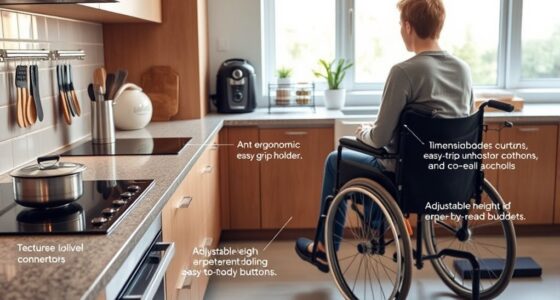
To assess accessibility effectively, use a mix of professional evaluations and DIY checklists. Professional reviews bring expert insights and thorough analysis, while checklists help you quickly spot basic issues like signage or lighting. Combining both approaches ensures you don’t miss key barriers and can make practical improvements that truly support all users. Continuing on will help you understand how to balance these methods for the best results.
Key Takeaways
- Professional evaluations provide expert insights and comprehensive analysis beyond basic standards.
- DIY checklists offer quick, cost-effective tools for initial accessibility assessments.
- Combining both methods ensures thorough evaluation of standards and real-world user experience.
- Checklists help identify simple barriers, while professionals address complex accessibility issues.
- Ongoing assessments with both approaches support continuous improvement and inclusive design.

Evaluating accessibility is a crucial step in making certain that environments, products, and services are usable by everyone, regardless of their abilities. When you appraise accessibility, you’re making sure that people with diverse needs can navigate spaces, use devices, and access information without unnecessary barriers. One essential tool in this process is assistive technology, which includes devices like screen readers, magnifiers, or alternative input devices that help individuals with disabilities interact with their surroundings. Incorporating assistive technology into your evaluation enables you to understand how well your environment or product supports different user needs. Additionally, understanding design standards for accessibility ensures that your assessments align with established guidelines and best practices. User testing is another critical component of evaluating accessibility. By observing real users—especially those with disabilities—you gain valuable insights into how your design performs in practical, everyday situations. User testing helps you identify unforeseen obstacles that static checklists might overlook. It’s about stepping into the shoes of your users and seeing firsthand what works and what doesn’t. When you conduct user testing, you can gather direct feedback on how accessible your environment feels, whether assistive technology integrates smoothly, and if navigation is intuitive. This hands-on approach ensures your evaluations are grounded in real-world experiences, making your improvements more targeted and effective.
While professional evaluations bring expert knowledge into the mix, DIY checklists empower you to conduct preliminary assessments quickly and cost-effectively. These checklists typically cover basic accessibility standards, such as appropriate signage, clear pathways, and proper lighting. They serve as a practical starting point, especially if you’re aiming to improve accessibility without immediately engaging experts. However, don’t rely solely on checklists; they’re meant to complement, not replace, thorough user testing and professional evaluations. Combining these methods ensures a thorough approach—balancing technical standards with real user experiences.
Incorporating assistive technology into your testing process can reveal how well your environment accommodates different needs. For example, checking if a website is compatible with screen readers or if a building’s signage is visible for users with visual impairments helps you identify gaps. When you involve users with disabilities in your evaluations, you’re more likely to discover practical issues that might otherwise be missed. This approach not only improves usability but also demonstrates your commitment to inclusivity.
Ultimately, evaluating accessibility isn’t a one-time task—it’s an ongoing process. By leveraging assistive technology, conducting user testing, and utilizing professional evaluations alongside DIY checklists, you create a feedback loop that continually enhances your environment’s accessibility. This proactive stance benefits everyone, ensuring your spaces, products, and services are welcoming, usable, and equitable for all users.
Frequently Asked Questions
How Often Should Accessibility Assessments Be Updated?
You should update your accessibility assessments whenever you make significant changes to your website or environment, or at least annually. Regular reviews guarantee your assistive technology remains effective and that you stay compliant with legal requirements. Keeping assessments current helps identify new barriers and maintain legal compliance, so you avoid potential penalties and ensure everyone can access your content or services. Consistent updates are key to ongoing accessibility and legal adherence.
What Are Common Overlooked Accessibility Issues?
You often overlook issues like visual impairments and mobility barriers, which can greatly impact accessibility. Common overlooked problems include inadequate signage for those with visual impairments, narrow doorways that block wheelchairs, and high counters that are difficult to reach. You might also miss subtle hazards like uneven flooring or improper lighting. Addressing these issues ensures your space is truly accessible, helping everyone navigate comfortably and safely.
Can DIY Checklists Replace Professional Evaluations Entirely?
Did you know 60% of accessibility issues remain unnoticed with DIY checklists? While they’re helpful for initial reviews, DIY pitfalls include missing nuanced problems that professional evaluations catch. Relying solely on checklists can lead to evaluation limitations, overlooking areas needing expert insight. For thorough accessibility, you should combine DIY tools with professional assessments. This way, you guarantee your space truly meets all accessibility standards and serves everyone effectively.
How Do Accessibility Standards Vary Across Regions?
You should know that accessibility standards vary across regions, affecting local compliance requirements and cultural considerations. Different countries or areas may have unique regulations, design expectations, and interpretations of accessibility, so what works in one place might not meet another’s standards. Always research regional compliance and cultural factors before implementing accessibility measures to guarantee your efforts are effective, respectful, and legally compliant in each specific area.
What Tools Are Recommended for Remote Accessibility Assessments?
Think of remote accessibility assessments as exploring a digital landscape from afar. You should use tools like assistive technology simulators, screen readers, and browser extensions to mimic user experiences. Incorporate user testing with diverse individuals, including those with disabilities, to gather real-world insights. These tools help you identify barriers effectively, ensuring your digital content is truly accessible from anywhere, making your efforts as exhaustive as a detailed map guiding every traveler.
Conclusion
You might think professional evaluations are the only way to guarantee accessibility, but DIY checklists can be surprisingly effective. The truth is, with a keen eye and some research, you can identify many barriers yourself. While experts bring experience, your firsthand perspective is invaluable. Combining both approaches offers the best chance to create truly inclusive spaces. So, don’t underestimate your ability—sometimes, your own observations are the most powerful tool for positive change.