For a beginner who wants room to learn without assembling a separate grinder setup, I’d make the Breville Barista Express my best overall pick; its integrated grinder brings more control but also adds steps. The Breville Bambino is a simpler compact alternative, while the De’Longhi Stilosa offers a more hands-on, straightforward starting point. The main tradeoff is between convenience and control: simpler machines reduce setup, while more capable options ask you to learn grinding, tamping, and milk steaming. Compact models save counter space, but some leave less room to grow or provide fewer controls. Read on for the full breakdown of which machine best fits your routine, space, and appetite for learning.

Get the little things that make your day delivered free with Prime
- Fast, free delivery on millions of items
- Prime Video, Amazon Music and more included
- Member-only deals all year
Complete the kit


Key Takeaways
- The Barista Express stands apart for an all-in-one learning setup: its integrated grinder means beginners can control more variables without buying a separate grinder, though it takes more practice than simpler machines.
- The Bambino prioritizes a smaller footprint and a simpler workflow: it suits buyers who already have a grinder or prefer not to add one to the machine.
- The Stilosa favors hands-on simplicity over built-in convenience: it is a sensible entry point for learners willing to grind and prepare coffee separately.
- The CASABREWS 3700 and CM5418 show why capacity and counter space matter: compare their footprints and water setups against your daily routine rather than choosing on pressure claims alone.
- Feature-heavy and high-pressure claims do not automatically make a better beginner machine: prioritize clear controls, reliable workflow, and straightforward cleaning over headline numbers.




| espresso machine for beginner | Pump pressure | Power |
|---|---|---|
| De’Longhi Stilosa Compact Manu | — | — |
| CASABREWS 3700 Essential Stain | 20 bar | — |
| Breville Barista Express Espre | — | 1600 W |
| CASABREWS CM5418 Compact Espre | 20 bar | — |
| XIXUBX Espresso Machine with M | — | — |
| Chefman CraftBrew Digital Espr | 15 bar | 1350 watts |
| Atatix Espresso Machine with M | 20 bar | — |
| 3.5-Bar Espresso Machine | — | 800 watts |
| Compact 20-Bar Espresso Machin | 20 bar | 1450 watts |
| Breville Bambino Espresso Mach | — | 1560 watts |
More Details on Our Top Picks
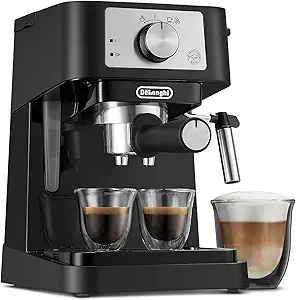
De’Longhi Stilosa Compact Manual Espresso Machine with Milk Frother
The De’Longhi Stilosa is a good fit for a beginner who wants to learn basic espresso preparation without giving up much counter space. Its single- and double-shot filters make it easy to choose a serving size, while the manual milk frother lets you practice making cappuccinos and lattes. Compared with the larger Breville Barista Express, the Stilosa leaves out an integrated grinder and advanced temperature controls, so there are fewer tools to manage but also less help dialing in a shot. Its two-level cup holder is a practical touch for switching between shorter espresso cups and taller drinkware. The tradeoff is hands-on work: you supply the coffee preparation and control the milk yourself, so it suits curious beginners better than anyone seeking push-button convenience.
Pros:- Compact design takes up less counter space than the Breville Barista Express.
- Manual frother supports cappuccinos, lattes, and flat whites.
- Includes filters for single and double espresso.
- Two-level cup holder accommodates different cup heights.
Cons:- Manual brewing and milk frothing demand more effort than an automatic machine.
- No integrated grinder is listed, so fresh-bean preparation requires separate equipment.
- The description does not list guided temperature or extraction controls.
Best for: Beginners with limited counter space who want to learn manual espresso and make occasional milk drinks.
Not ideal for: People who want an integrated grinder, guided extraction controls, or automatic milk preparation.
- Machine type:Manual espresso machine
- Milk frother:Manual
- Boiler:Stainless steel
- Included filters:Single and double espresso
- Cup holder:Two-level
- Drink options:Espresso, cappuccino, latte, and flat white
Our verdict“Choose the Stilosa if a small footprint and hands-on practice matter more to you than built-in grinding or automation.”
CASABREWS 3700 Essential Stainless Steel Espresso Machine with Steam Wand
The CASABREWS 3700 Essential suits beginners who want semi-automatic brewing and a removable reservoir that can support several servings before a refill. Its 43.9-ounce water tank is larger than the 34-ounce tank on the CASABREWS CM5418, a useful distinction for an office or a household where more than one person makes coffee. The steam wand and included one- and two-cup filters cover the basics without requiring a built-in grinder; it takes ground coffee, keeping the setup straightforward if you already have a grinder. The tradeoff is that beginners still need to manage the brewing and milk frothing themselves, and the supplied information calls for a first-use cycle before brewing. Choose it over the smaller CM5418 for reservoir capacity, not for advanced guidance: no pressure gauge or temperature control is listed.
Pros:- Removable 43.9-ounce tank holds more water than the CASABREWS CM5418’s 34-ounce tank.
- Steam wand allows milk frothing for espresso-based drinks.
- One-cup and two-cup filters support different serving sizes.
- Includes a portafilter and tamper with spoon.
Cons:- Requires a first-use cycle before brewing.
- The tank still needs refilling with frequent or shared use.
- Manual milk frothing and semi-automatic brewing take practice.
Best for: Households or small offices where several people want ground-coffee espresso drinks and fewer water refills.
Not ideal for: Beginners seeking an integrated grinder, programmable brewing, or a machine with listed extraction guidance.
- Operation mode:Semi-automatic
- Pump pressure:20 bar
- Wattage:1350 watts
- Voltage:120 volts
- Water tank capacity:43.9 oz, removable
- Coffee input:Ground coffee
- Milk frothing:Steam wand
- Included accessories:One-cup and two-cup filters, portafilter, tamper with spoon, and instruction manual
Our verdict“Pick the 3700 Essential if a larger removable tank matters more than compact size or built-in extraction guidance.”
Breville Barista Express Espresso Machine, Brushed Stainless Steel
The Breville Barista Express is the most capable learning setup here for a beginner who wants to work with whole beans and build repeatable espresso skills. Its integrated conical burr grinder sends freshly ground coffee into the portafilter, while PID temperature control and low-pressure pre-infusion offer more extraction support than the simpler CASABREWS 3700 Essential. That extra control can make the process more instructive, but it also gives a new user more variables to learn. The 67-ounce tank and included milk jug, tamper, baskets, and cleaning tools make it a substantial all-in-one station rather than a compact starter machine. Unlike the De’Longhi Stilosa, it includes its own grinder; unlike a more automated option, brewing and milk texturing remain manual. Skip it if you want minimal setup or minimal practice.
Pros:- Integrated conical burr grinder grinds beans directly into the portafilter.
- PID temperature control and low-pressure pre-infusion support more controlled extraction.
- 67-ounce water tank reduces refill frequency compared with smaller-tank options.
- Includes a milk jug, tamper, baskets, portafilter, and cleaning tools.
Cons:- Manual brewing and milk texturing require more practice than the CASABREWS 3700 Essential.
- The integrated grinder and broader controls may feel like a lot for someone seeking a simple first machine.
- Warranty is limited to one year.
Best for: New espresso enthusiasts who want an integrated grinder and are willing to practice dialing in shots and texturing milk.
Not ideal for: Buyers who want a compact, low-effort machine or prefer automatic drink preparation.
- Model:BES870XL
- Type:Manual espresso machine
- Grinder:Integrated precision conical burr grinder
- Bean hopper capacity:1/2 lb
- Water tank capacity:67 oz
- Power:1600 W
- Temperature control:Digital PID
- Shot settings:Single or double
- Warranty:1-year limited
Our verdict“Choose the Barista Express if you want one machine for grinding and hands-on skill-building, and are comfortable with a steeper learning curve.”
CASABREWS CM5418 Compact Espresso Machine with Milk Frothing Wand
The CASABREWS CM5418 gives beginners a visible cue for dialing in espresso: its pressure gauge shows extraction pressure, making it more informative than the De’Longhi Stilosa, which has no gauge listed. Its steam wand and semi-automatic operation also cover the usual espresso-and-milk routine in a compact stainless-steel design. The smaller 34-ounce removable tank helps keep the machine manageable, but it holds less than the CASABREWS 3700 Essential’s 43.9-ounce reservoir, so frequent drink makers may refill more often. There is another learning wrinkle: the machine must cool after frothing milk before brewing, interrupting the sequence for anyone making drinks back-to-back. The product information also notes that pressure issues may call for adjustments to grind, dose, or tamping. This is better for a patient beginner than someone expecting a seamless one-touch routine.
Pros:- Pressure gauge gives a visible reference while learning extraction.
- Removable tank is easier to refill than a fixed reservoir.
- Steam wand supports milk texturing for cappuccinos and lattes.
- Includes one-cup and two-cup filters, a portafilter, and a tamper with spoon.
Cons:- 34-ounce tank is smaller than the CASABREWS 3700 Essential’s 43.9-ounce tank.
- Needs to cool after frothing milk before brewing.
- Extraction may require adjustments to grind size, coffee dose, or tamping.
Best for: Beginners who want a compact semi-automatic machine and a pressure gauge to help observe extraction.
Not ideal for: People who regularly prepare several drinks in a row or want to switch from steaming milk to brewing without a cooling pause.
- Type:Semi-automatic espresso machine
- Pump pressure:20 bar
- Wattage:1350 W
- Water tank capacity:34 oz, removable
- Milk frothing:Steam wand
- Material and finish:Brushed stainless steel
- Included components:Removable water tank, one-cup and two-cup filters, portafilter, tamper with spoon, and instruction manual
- Pressure gauge:Included
Our verdict“Choose the CM5418 if you want a compact machine with a pressure gauge and can accept a pause between steaming and brewing.”
XIXUBX Espresso Machine with Milk Frother, Stainless Steel
The XIXUBX espresso machine has a practical edge for beginners focused on milk drinks: it includes a stainless steel frothing pitcher, so there is no need to source that basic accessory separately. Its 360-degree rotating, detachable steam wand is designed for easier positioning and cleaning, while the visible pressure gauge gives the user a cue during extraction. Compared with the CASABREWS CM5418, this model has a larger 42-ounce tank, though the CM5418’s listing specifies one- and two-cup filters and a tamper with spoon. The XIXUBX description does not list programmable settings, grinder support, or dimensions, leaving beginners with less information about customization and counter fit. Its feature set suits someone learning to make espresso and steamed-milk drinks, but not a buyer who wants clearly documented automation or a complete set of brewing controls.
Pros:- 42-ounce water tank is larger than the CASABREWS CM5418’s 34-ounce tank.
- Includes a stainless steel milk frothing pitcher.
- Detachable 360-degree rotating steam wand is designed for easier cleaning and positioning.
- Visible pressure gauge provides an extraction reference.
Cons:- No programmable settings are listed in the product information.
- Dimensions and weight are not provided, making counter-fit planning harder.
- The supplied details do not specify included filters or a tamper.
Best for: Beginners who expect to make milk-based drinks and want a machine that includes a frothing pitcher.
Not ideal for: Buyers who need listed dimensions before choosing a machine, or want programmable settings and a documented grinder setup.
- Pressure:20 bar
- Water tank capacity:42 oz
- Steam wand:360° rotating and detachable
- Body material:Stainless steel
- Included accessory:Stainless steel milk frothing pitcher
- Pressure gauge:Visible
- Heating:Fast heating
- Warranty:1 year
Our verdict“Pick the XIXUBX if you want a pitcher included and a larger tank, but verify its size and brewing accessories before choosing it.”
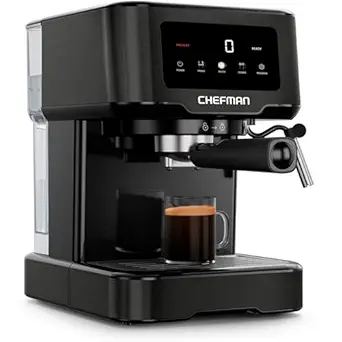
Chefman CraftBrew Digital Espresso Machine with Steam Wand, 15-Bar Pump, 1.5L Removable Water Reservoir, Stainless Black
The Chefman CraftBrew suits beginners who want some control without starting with a fully manual setup. Its digital touch controls and programmable shot volumes make it easier to repeat a preferred cup or switch between shorter and longer pulls; the built-in steam wand adds room to learn milk drinks. Compared with the Breville Bambino, it offers programmable volume rather than a three-second heat-up claim, so it may appeal more to someone who values setting a repeatable shot than shaving time off the morning routine. The tradeoff is that it still uses semi-automatic operation: beginners must learn the portafilter and milk-steaming steps themselves. Its 1.5-liter removable tank is practical, though regular descaling is part of upkeep.
Pros:- Programmable shot volumes help beginners repeat a preferred serving size.
- Built-in steam wand supports cappuccinos and lattes.
- Removable 1.5-liter tank makes refilling and cleaning more convenient.
- Compact dimensions suit counters with limited space.
Cons:- Semi-automatic operation takes more practice than a fully automatic machine.
- Requires regular descaling after 500 brewing cycles.
Best for: New home baristas who want programmable shot volumes, a steam wand, and a removable tank while learning semi-automatic espresso.
Not ideal for: Anyone seeking one-touch drinks or minimal technique practice; semi-automatic brewing and milk steaming require hands-on learning.
- Model:RJ54-SS-15-D-BLK
- Operation:Semi-automatic
- Pump pressure:15 bar
- Water tank:1.5 liters, removable
- Power:1350 watts
- Dimensions:10.8 × 8.9 × 11.9 inches
- Coffee input:Ground coffee
- Warranty:1 year
Our verdict“Choose the Chefman if you want beginner-friendly shot programming but are willing to learn hands-on brewing and milk steaming.”
Atatix Espresso Machine with Milk Frother, 20-Bar Pressure
The Atatix gives beginners a choice between automatic shot programs and manual extraction, which makes it a useful bridge from simple operation to experimenting with brew length. Automatic single and double settings provide a starting point; manual mode lets curious users adjust extraction time. That flexibility sets it apart from the Chefman CraftBrew, whose programmable volumes favor saving a chosen result over hands-on timing. The Atatix also includes a steam wand and removable tank, but its stated manual mode can run for up to 102 seconds, so it asks more of a learner than a simple preset machine. The tank capacity is not specified, making it harder to judge how often refilling will be needed. Choose it for practice and options, not for a fully guided workflow.
Pros:- Automatic and manual extraction modes support different skill levels.
- Specified single- and double-shot programs offer a straightforward starting point.
- Steam wand allows practice with milk-based drinks.
- Detachable tank and drip tray simplify routine cleaning.
Cons:- Manual extraction requires the user to set and manage brew time.
- Water tank capacity is not provided in the product details.
- ABS and stainless steel construction may be less appealing to buyers seeking an all-metal body.
Best for: Beginners who want automatic starting points but also plan to experiment with extraction time and milk frothing.
Not ideal for: Buyers who want a clearly stated tank capacity or a machine that handles milk drinks with little hands-on effort.
- Pump pressure:20 bar
- Temperature control:90–96°C
- Preheat time:30 seconds
- Extraction modes:Automatic and manual
- Automatic single shot:28 seconds; 25–40 g
- Automatic double shot:42 seconds; 55–85 g
- Manual extraction:Up to 102 seconds; 180–350 g
- Materials:ABS and stainless steel
Our verdict“Pick the Atatix if you want presets for early practice and manual extraction options as your confidence grows.”
3.5-Bar Espresso Machine, 4-Cup Compact Coffee Maker, 800W, Black
This compact machine is the simplest fit here for someone who values basic controls and up to four cups over the feel of a conventional high-pressure espresso setup. Its carafe-style capacity suits shared servings, while removable parts make cleanup less involved. That makes it a different beginner choice from the Atatix, which offers automatic and manual extraction modes for users who want to learn shot adjustments. The key compromise is its 3.5-bar pressure, far below the 15- and 20-bar pumps listed for the Chefman and Atatix; buyers should not expect the same espresso preparation approach from those machines. It also calls for medium-coarse grounds, which narrows the grind choice. Consider it for uncomplicated, occasional drinks—not for learning traditional espresso technique.
Pros:- Brews up to four cups in one batch.
- Simple controls keep the basic brewing process approachable.
- Built-in steam wand supports cappuccinos and lattes.
- Removable filter, holder, and carafe make cleaning easier.
Cons:- 3.5-bar pressure differs substantially from the higher-pressure machines in this roundup.
- Best results call for medium-coarse grounds, limiting grind flexibility.
- 800-watt power is lower than the Chefman and Breville Bambino.
Best for: Dorm residents, office users, or small households who want simple controls and a carafe that can serve several cups.
Not ideal for: Beginners seeking a conventional high-pressure espresso setup, fine control over extraction, or compatibility with a wider range of grind sizes.
- Pressure:3.5 bar
- Capacity:Up to 4 cups
- Power:800 watts
- Color:Black
- Milk frother:Built-in steam wand
- Removable parts:Filter, filter holder, carafe, measuring spoon
- Recommended grind:Medium-coarse
Our verdict“Choose this machine for simple small-batch coffee-style drinks, but skip it if your goal is to learn high-pressure espresso brewing.”
Compact 20-Bar Espresso Machine with Milk Frother, 34 oz Water Tank, Stainless Steel
With a listed width of just 5.3 inches, this machine is the space-saving option for beginners who still want a steam wand and a pressure gauge. The removable 34-ounce tank is more informative than the Atatix listing, which leaves tank capacity unstated, and the roughly 20-second preheat gives a clear sense of its ready-up pace. The gauge can help make pressure visible, but it does not remove the need to prepare coffee and manage the brewing process. Compared with the Breville Bambino, this pick emphasizes a narrow footprint and a gauge, while the Bambino specifies PID temperature control and a three-second heat-up. A practical drawback is the required cooling period between frothing and brewing when overheat protection is triggered; allow time to preheat before use.
Pros:- Narrow 5.3-inch dimension helps preserve counter space.
- Pressure gauge makes pressure visible during operation.
- Removable 34-ounce tank and drip tray aid refilling and cleanup.
- Steam wand supports milk frothing and latte art practice.
Cons:- May need to cool between steaming milk and brewing to avoid overheat protection.
- Preheating is recommended, so the stated heat-up time does not cover every step before brewing.
- Product details do not specify a temperature-control system.
Best for: Apartment dwellers and first-time espresso makers with a narrow counter who want a removable tank, gauge, and steam wand.
Not ideal for: People who need to brew coffee and steam milk back-to-back without pauses, or who want a specified temperature-control system.
- Pump pressure:20 bar
- Power:1450 watts
- Preheat time:About 20 seconds
- Water tank:34 oz, removable
- Dimensions:5.3 × 12.2 × 11.5 inches
- Material and finish:Stainless steel
- Features:Pressure gauge, steam wand, removable drip tray
Our verdict“Choose this compact model if counter width is tight and you can accommodate preheating and cooling pauses.”
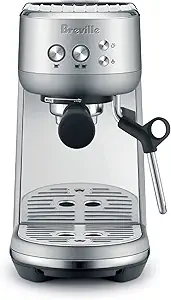
Breville Bambino Espresso Machine, Brushed Stainless Steel (BES450BSS)
The Bambino is the strongest fit here for a beginner who wants fast startup and defined brewing controls without moving to a larger machine. Its ThermoJet system reaches extraction temperature in three seconds, while PID control and low-pressure pre-infusion address temperature and the start of extraction—useful details for someone learning to make repeatable drinks. Compared with the Chefman CraftBrew, it specifies more about temperature management and includes a milk jug and tamper, but it does not offer programmable shot volumes. The tradeoff is hands-on preparation: the user still handles the portafilter, dosing, and milk texturing. Its settings cover one- or two-cup brewing, steam, and hot water, so buyers seeking extensive customization or automatic drinks should look elsewhere. It is compact, but still expects active participation.
Pros:- ThermoJet heating system reaches extraction temperature in 3 seconds.
- Digital PID temperature control supports a defined brewing process.
- Low-pressure pre-infusion helps introduce extraction gradually.
- Includes portafilter, filter baskets, milk jug, tamper, and cleaning accessories.
Cons:- Requires manual espresso preparation, including handling the portafilter.
- Brewing settings are limited to one- or two-cup options.
- Milk drinks require the user to texture milk with the steam wand.
Best for: New home baristas who want quick heat-up, temperature control, and included tools while learning manual espresso preparation.
Not ideal for: People who want one-touch drinks, programmable shot volumes, or multiple brew-size settings beyond one- and two-cup options.
- Model:BES450BSS
- Finish:Brushed stainless steel
- Heating system:ThermoJet
- Heat-up time:3 seconds
- Temperature control:Digital PID
- Portafilter:54 mm; 19 g dose
- Power:1560 watts
- Settings:1 cup, 2 cups, hot water, steam
- Warranty:1-year limited
Our verdict“Choose the Bambino if fast readiness and temperature-focused controls matter more than automatic drinks or programmable shot volumes.”

How We Picked
I ranked these machines by how well their features support a beginner’s first months of making espresso: understandable controls, a workable path from beans to a shot, milk-steaming access, and a setup that does not demand more counter space or maintenance than the buyer wants. I also weighed practical details such as removable water tanks, included grinder capability, and whether a machine leaves room to learn. Product names and feature listings do not establish that every model performs alike, so I did not treat pump-pressure figures as a shortcut for shot quality.
The ranking favors useful combinations of beginner access and flexibility. The Barista Express leads for buyers who want grinding and espresso in one station; the Bambino and Stilosa rank well for different priorities—compactness and hands-on simplicity. The CASABREWS, Chefman, XIXUBX, Atatix, and generic compact models may suit narrower needs, but buyers should compare their controls, dimensions, and included accessories carefully. The 3.5-bar four-cup machine sits apart from the conventional pump-style options, so I would not choose it expecting the same espresso-making workflow.
Factors to Consider When Choosing Espresso Machine For Beginners
Before choosing, decide what you want to learn and what you want the machine to handle for you. Beginners often focus on pressure figures or appearance, but daily workflow, grinder access, and cleaning demands have a bigger effect on whether a machine feels manageable. These factors can help narrow the field beyond the individual model comparisons.
Choose How Much of the Coffee Workflow You Want to Own
Espresso depends on more than the machine: the grinder, coffee dose, tamp, and shot timing all affect the result. An integrated grinder, as on an all-in-one design, can simplify shopping and keep the setup together, but it also adds adjustments to learn and another component to maintain. A machine without a grinder can be easier to understand at first, yet a suitable grinder becomes a separate purchase and takes counter space. Avoid buying a standalone machine before checking whether your current grinder can produce a fine, consistent espresso grind. If you want to learn each step, separate equipment offers flexibility; if you want fewer purchasing decisions, an integrated setup may suit you better.
Match the Learning Curve to Your Routine
Manual preparation gives you control, but that control can feel like extra work on a rushed morning. Think about whether you want to measure and tamp coffee each time or would rather prioritize a more direct routine. A machine with more adjustments can teach you how grind and dose affect a shot, though it asks for experimentation before results become consistent. Simpler controls can reduce friction, but they do not remove the need for suitable coffee or basic upkeep. A common mistake is choosing the most feature-rich option while expecting it to behave like a one-button brewer. Pick for the routine you will repeat, not only the skills you hope to develop.
Treat Milk Steaming as a Separate Skill
A steam wand lets you make milk drinks, but it does not make steaming automatic. Beginners need space to position a pitcher, time the process, and clean the wand soon after use. If you mostly drink straight espresso or americanos, a wand may add clutter without much daily value. If lattes are the goal, check that the machine has a wand and consider whether you are willing to practice milk texture as well as shot preparation. Do not assume every included wand is equally easy to use; wand design and machine workflow can vary. Buyers who regularly make drinks for several people should also think about how much repeated steaming their routine involves.
Measure the Whole Setup, Not Just the Machine
Compact machines can suit a small kitchen, but you still need room to fill the tank, fit a cup, handle a portafilter, and store coffee tools. Measure the counter depth and the vertical clearance beneath cabinets, including space needed to lift a lid or remove a reservoir. An integrated grinder can take up more room than a compact espresso unit, while a separate grinder adds another footprint beside it. Check whether the water tank is removable or easy to access where the machine will sit. A machine that technically fits but is awkward to refill can become a daily annoyance. Leave a nearby spot for a tamper, pitcher, and cleaning brush if you plan to use them.
Look Beyond Pressure Numbers
Marketing often emphasizes pump pressure, but a large number by itself does not tell you how consistently a machine extracts coffee or how easy it is to use. For a beginner, clear controls, a suitable grinder, and a repeatable preparation routine matter more than a headline specification. Be cautious about comparing machines by bar rating alone, especially when other details about controls, baskets, and temperature behavior are not clear. The low-pressure four-cup model in this roundup also serves a different kind of coffee-making routine from the pump-style espresso machines. Confirm what kind of drink and process a listing actually describes before treating it as a direct substitute. Choose based on the brewing workflow you want, not a single figure.
Plan for Cleaning and Future Upgrades
Daily rinsing and occasional deeper cleaning are part of owning an espresso machine, and milk steaming adds its own cleanup. A removable reservoir and accessible drip tray can make routine care less fiddly, while an integrated grinder adds grounds management. Before buying, check the manual for cleaning steps and any recommended descaling schedule rather than assuming maintenance is identical across machines. Think about which upgrade you might want first: a better grinder, a scale, a milk pitcher, or a machine with more control. Paying for a feature you will not use is less helpful than choosing a setup that leaves room for the skill or accessory you actually want to add. A beginner setup should feel manageable now and make sense as your routine changes.
Frequently Asked Questions
Should I buy a machine with a built-in grinder or a separate grinder?
A built-in grinder reduces the number of separate devices and can make the Barista Express a practical all-in-one starting point. It also ties the grinder and machine together, so changes or upgrades may be less flexible than with separate equipment. A separate grinder makes sense if you already own one that can grind finely and consistently enough for espresso. Before choosing a machine without a grinder, confirm the capability of the grinder you have; many general-purpose grinders are not suited to espresso. If you are starting from scratch, compare the full setup you need rather than the machine alone.
Is a compact machine a good choice if I want to make lattes?
It can be, provided the machine includes a steam wand and you have enough room to use it with a pitcher. Compactness describes the machine’s footprint, not how easy milk steaming will feel or how quickly you can make multiple drinks. You will need to practice steaming and clean the wand after use, so consider whether that fits your routine. Also measure the space around the machine, since a pitcher and milk storage take room beyond the appliance itself. If milk drinks are your main goal, weigh wand access and workflow alongside size.
Do I need a machine with a 20-bar pump to make good espresso?
No single pressure rating can tell you whether a machine will suit your needs or produce a satisfying shot. Grind consistency, coffee preparation, controls, and the machine’s brewing design all matter to the result. This roundup includes several machines marketed with high pressure figures, but that number alone does not establish an advantage over the other picks. Compare the operating details and the kind of brewing process each model supports. For a beginner, a clear and repeatable workflow is a more useful buying signal than a headline pressure figure.
Is the 3.5-bar four-cup machine comparable to the pump espresso models?
Not directly: its four-cup format and lower pressure rating suggest a different brewing approach from the conventional pump-style machines in this list. It may appeal to someone who values a compact multi-cup appliance, but buyers seeking a hands-on espresso workflow should check its brewing method and expected drink output before choosing it. Do not assume that every machine labeled for espresso uses the same process or makes interchangeable results. Compare the product instructions and included components, not just the category label. If learning traditional espresso preparation is your aim, focus on the pump-style options.
When is it worth choosing a more involved machine as a beginner?
A more involved setup can make sense if you want to learn how grinding and preparation affect the shot rather than simply make coffee with minimal steps. The Barista Express brings a grinder into the same unit, while the Bambino keeps the machine compact for buyers who already have a grinder or prefer to choose one separately. That extra capability can also mean more adjustments, cleanup, and counter space. Decide whether you will use those controls regularly, not just whether they sound useful. If your priority is a simple daily drink, a less involved machine may be a better fit.
Conclusion
For the best overall balance of learning and convenience, choose the Breville Barista Express if you want a grinder built into the same setup and are willing to practice. For best value in a hands-on starter approach, the De’Longhi Stilosa is the straightforward pick, especially if you already have a capable grinder. The Breville Bambino is my best choice for beginners who value a compact machine and do not need an integrated grinder. For a more feature-rich or multi-use station, compare the Chefman and CASABREWS models against your preferred controls, tank access, and available counter space before deciding. If compact size is the leading need, assess the CM5418, XIXUBX, Atatix, and other small-format options by their actual dimensions and workflow; choose the 3.5-bar four-cup model only if its distinct brewing style matches what you want. The right pick is the one whose daily steps you will enjoy repeating—not simply the one with the biggest specification number.
NFL season / tailgating Picks
team gear
As an affiliate, we earn on qualifying purchases.