
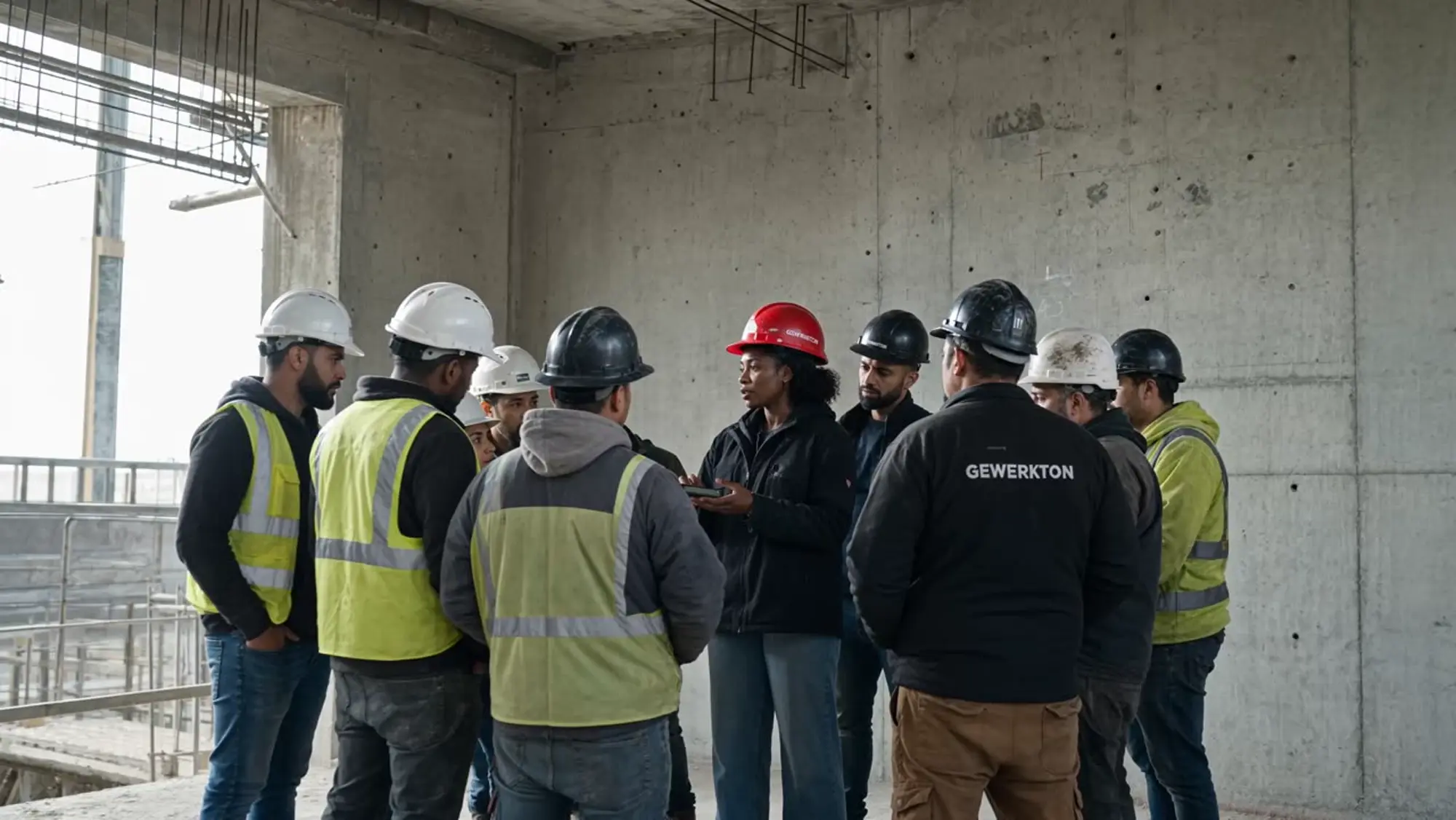
A construction site does not pause while someone finds the right form. Decisions are made beside unfinished walls, on scaffolding and across large, distributed projects where the people doing the work may speak several different languages. Gewerkton starts with that reality. It is a voice-first construction documentation and defect management platform designed for global markets: dictate what happened on site, then turn that account into structured evidence connected to details such as a photograph, deadline or signature.
Listen free for 30 days with Audible
Thousands of audiobooks and originals — cancel anytime.
Start your free trialAs an affiliate, we earn on qualifying purchases.
Gewerkton · a beta built at human scale
One founder.
27 languages.
A new voice for construction sites.
A solo founder is directing coding agents to build a global, voice-first system that turns spoken site accounts into structured evidence.
Voice is the starting point—not an add-on.
A spoken account captured while the circumstances are immediate becomes evidence that people can verify, assign and act on.
Three connected product lines
Language, provider and data location
Teams across the EU, US and APAC can work in their own languages while retaining unambiguous original evidence. AI providers can be selected by region—including mainland China—and data can reside in an EU cloud or on the organisation’s own infrastructure.
21 packages shipped in one night
The coding-agent fleet delivered 21 software packages, checked with negative controls and mutation tests—a compact operating model aimed at a much larger system.
“On site, what counts is what’s proven.”
The idea is carried by an unusually compact human story. Gewerkton is being built by a solo founder directing a fleet of coding agents using Codex and Claude. In one night, that fleet shipped 21 software packages, which were verified with negative controls and mutation tests. Behind the technical language is a straightforward model: one founder coordinating software agents to build and check many parts of a much larger system.
The product is in beta now, and a public beta is planned for fall 2026. That status matters. Gewerkton is not being presented as a finished platform already established across every kind of project. It is an ambitious beta built around a clear observation, expressed in its marketing line: “On site, what counts is what’s proven.”
From a spoken account to structured evidence
Voice is the centre of the proposition, rather than a feature added at the edge. A person on a scaffold can dictate an account while the circumstances are immediate. The system is intended to connect that account with the evidence and follow-up information a project needs, including photos, deadlines and signatures.
This approach is especially relevant because construction records cover much more than a simple note. Teams may need to capture defects, prepare daywork reports, record instructions, preserve original audio or turn meeting decisions into task lists organised by trade. Gewerkton brings those activities into one branded house with three product lines: Field, Studio and Cloud.
The broader Gewerkton platform was born in the German market and has its deepest commercial integration there, including GAEB, REB, XRechnung and DATEV. At the same time, its scope is explicitly global. It supports 27 content languages and lets organisations select AI providers by region, including providers in the EU, US and Asia, with mainland China included.
Three connected product lines
Gewerkton Field
Gewerkton Field is the voice-first construction site app. It covers dictation to evidence, defects, daywork reports, takt and portal functions. Takt refers to the planned rhythm or sequence of work on a project, helping teams follow how activities move through a site.
Field is where the voice-first idea becomes most tangible. A record can begin with a spoken account rather than waiting for someone to type it up later. In housing and building construction, that may mean recording a defect with a photo and deadline, dictating a daywork report or collecting a signature on a device during handover. In infrastructure and tunnel projects, it may mean backing an instruction with its original audio over the course of a long project with many change orders.
Gewerkton Studio
Gewerkton Studio is the browser workspace for plans and models. If no model exists, the site team can create one in the browser. That distinction makes the workspace relevant both to projects that already have digital models and to teams that need to establish one from the information available on site.
Studio gives the project’s visual information a place alongside its site records. It also reflects the platform’s wider effort to connect what is planned with what is actually captured, discussed and accepted during construction.
Gewerkton Cloud
Gewerkton Cloud handles operations and model or data coordination between Field, Studio and third parties. In practical terms, it is the connecting product line: Field captures site activity, Studio provides the browser workspace for plans and models, and Cloud coordinates the operational and data flows around them.
The three lines are not separate brands competing for attention. They are parts of the same Gewerkton system, each addressing a different location in the working day: the site, the browser workspace and the coordination layer between tools and participants.
Twenty-seven languages for the same project
Construction is often multilingual even when a project sits within one national border. Cross-border work makes the communication challenge still more visible. Gewerkton supports 27 content languages so teams in the EU, US and APAC can work on the same project, each in their own language, while the original evidence remains unambiguous.
For projects in Asia, the stated use cases include Chinese, Korean and Vietnamese crews, with multilingual handling from capture through to report. Language support is therefore tied to the working record, not limited to translating a marketing page or navigation menu.
The marketing site itself is available in 27 languages. It uses zero trackers, has no cookie banner and is built with a fully egress-free architecture. Gewerkton has also created a media bank containing more than 51 self-produced clips and posters. Together, those facts show how widely the solo-founder operation has approached the task: product development, international presentation and original media are all being assembled around the same launch.
Choice of AI provider and data location
Gewerkton’s BYO-AI model supports 13 AI providers. Users bring their own keys and can choose providers by region across the EU, US and Asia, including mainland China. The aim is to avoid vendor lock-in while allowing provider selection to reflect where a project operates.
Data residency is also presented as a choice: an EU cloud or the organisation’s own infrastructure. For teams working across borders, this combines regional AI-provider selection with control over where project data resides.

Different sites, one need for a reliable record
The platform’s deployment fields stretch across several kinds of construction and engineering work, but they share a common need: preserving what happened and making it usable by the people who must act next.
- Wind farms and renewable-energy projects involve distributed sites, rotating crews and field acceptance. Offline capture supports work in dead zones.
- Data centres and industrial plants may have many trades working in parallel against tight deadlines. Meeting decisions can become task lists sorted by trade.
- Housing and building projects can connect defects with photos and deadlines, support dictated daywork reports and capture signatures on a device at handover.
- Infrastructure and tunnel projects run for long periods and may involve many change orders. Instructions can be supported by their original audio.
- Cross-border projects can bring EU, US and APAC teams into the same project while allowing each participant to use their own language.
- Projects in Asia can support Chinese, Korean and Vietnamese crews from multilingual capture through to reporting, with data residency chosen by the organisation.
These examples explain why voice matters without turning it into a novelty. Speaking is the starting point; the value lies in what follows. A site account becomes evidence that can be connected to a photo, assigned a deadline, organised for the relevant trade or completed with a signature.
A beta with a distinctly human scale
There is a striking contrast at the centre of Gewerkton. Its intended market is global, its language support reaches 27 content languages, and its AI model spans 13 providers across several regions. Yet the operation behind it begins with one founder and a coordinated fleet of coding agents.
That does not make the beta status incidental. It makes it part of the story. Gewerkton is in beta now, with public beta planned for fall 2026. The current picture is of a platform taking shape across three connected product lines, grounded in the everyday need to capture what happened on site while the details are still close at hand.
Field carries the voice from the scaffold into a structured record. Studio connects that record with plans and models, including models created in the browser when none exists. Cloud coordinates operations and data among those products and third parties. Across all three, the central promise remains concise: on site, what counts is what’s proven.
NFL season / tailgating Picks
team gear
As an affiliate, we earn on qualifying purchases.