
TL;DR

Get the little things that make your day delivered free with Prime
- Fast, free delivery on millions of items
- Prime Video, Amazon Music and more included
- Member-only deals all year
Thorsten Meyer AI’s July 1, 2026 ISR Briefing says Ukraine’s Delta has become a leading example of software-defined warfare. The system fuses drones, satellite imagery, sensors and vetted reports into a live battlefield picture, but claims about scale and effects remain partly unverified.
Ukraine’s Delta is being framed in a new July 1, 2026 ISR Briefing as a working model of software-defined warfare, because its browser-based battlefield system fuses drones, satellites, sensors and vetted reports into a shared live map for frontline use.
Delta is a situational-awareness and battlefield-management system built around Ukraine’s military, with roles attributed to Aerorozvidka, the Defense Ministry’s defense-technology innovation center and the Ministry of Digital Transformation. According to the briefing, it draws on commercial and military drones, satellite imagery, sensor networks, partner intelligence and vetted field reports.
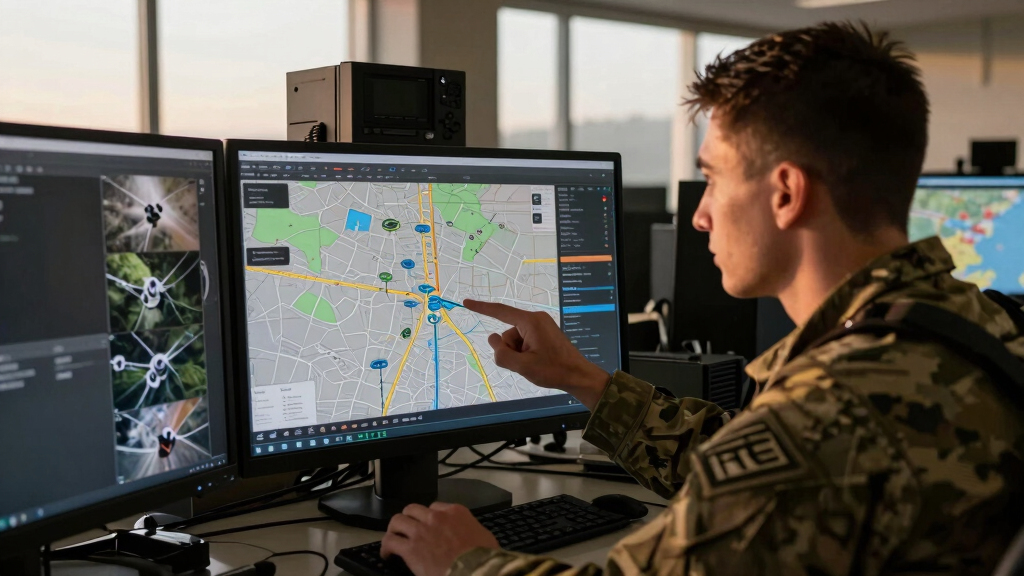
The system’s core function is not a single sensor. It is the fusion layer: geolocating inputs, placing them on a real-time map, attaching imagery of enemy assets and allowing units to plan, coordinate and share positions through secure channels. That makes Delta a common operating picture delivered as a web application.
The briefing says Delta’s backend is cloud-native and deliberately hosted outside Ukraine, while the client can run on ordinary phones, tablets and laptops. That design is presented as a resilience measure against missile strikes and cyberattacks, though dependence on connectivity remains a battlefield limit.
Software-defined warfare: how Ukraine’s Delta turned the battlefield into a shared, real-time map
A soldier opens a browser and sees the fused war — drones, satellites, sensors and vetted reports on one live map. The backend is a cloud deliberately hosted abroad so a missile can’t take it down. The clearest case yet of treating warfare as software.
Optical sensors go blind in cloud & dark; an all-weather SAR radar layer — the kind VigilSAR produces — slots into a picture like this as one resilient, sovereign input. vigilsar.com · And note the paradox: to survive missiles & cyberattack, Ukraine hosted its crown-jewel cloud outside its own borders — trading physical sovereignty for operational survivability. Resilience through distribution.
Delta’s lasting lesson isn’t a piece of software — it’s a model of how to build: commodity clients, cloud backend, open standards, relentless iteration, fusion over hardware, and resilience through distribution. It’s why a wartime NGO out-shipped procurement bureaucracies on a fraction of the budget. The platform mattered less than the picture — and the picture is software. Own the fusion layer, own the sovereign feeds into it, and get it to the edge.
Software Speed Pressures Procurement
For readers outside Ukraine, Delta matters because it points to a defense shift from exclusive reliance on expensive platforms toward data fusion, fast software updates and commodity hardware. If a soldier can access a fused battlefield picture from a browser, procurement, training and command systems face pressure to move faster.
The briefing also highlights a sovereignty trade-off. Hosting a wartime command cloud abroad may reduce the risk that a strike inside Ukraine takes the system offline, but it means part of a national military system depends on distributed infrastructure beyond the country’s territory.
browser-based battlefield management software
As an affiliate, we earn on qualifying purchases.
As an affiliate, we earn on qualifying purchases.
From NATO Trial To Frontline Tool
Delta traces its public story to work that the briefing says began in a 2017 NATO-related initiative aimed at breaking Soviet-style information silos. The system became broadly operational in August 2022 after Russia’s full-scale invasion forced Ukraine to move reconnaissance, targeting support and coordination closer to frontline units.
A 2024 CSIS analysis by Kateryna Bondar framed Delta as a lesson in software-defined warfare. Public accounts cited in the briefing describe a system developed at wartime speed by a mix of state bodies, technologists and volunteers, outside a traditional hardware procurement program.
“Delta is described as a case where the scarce resource is the fusion layer, not the sensor itself.”
— Thorsten Meyer AI ISR Briefing, July 1, 2026
Target Claims And Cyber Risks
The strongest performance figure remains a claim. The Ukrainian Defense Ministry has credited Delta with helping identify 1,500 confirmed Russian targets daily during one period, but the briefing states that number is not independently verified.
Other risks are also unresolved. A system that merges crowdsourced reports, sensor data and allied intelligence can face data-poisoning attempts, phishing, malware, jamming and outages. BleepingComputer reported that Delta users were targeted by info-stealing malware in December 2022.
Allies Watch The Fusion Layer
Military observers will be watching whether Ukraine can keep Delta’s fusion layer reliable under electronic attack and whether allied militaries adopt similar browser-based command tools. The next test is not only software performance, but how well NATO-aligned systems can share trusted data at speed.
Key Questions
What is Ukraine’s Delta system?
Delta is a Ukrainian situational-awareness and battlefield-management system that combines battlefield data feeds into a shared operational map.
Why is Delta described as software-defined warfare?
The term points to Delta’s reliance on software, data fusion and rapid updates, rather than a single weapons platform. Its browser-based access is central to that model.
Is the 1,500-target figure confirmed?
No. The 1,500 targets per day figure is attributed to the Ukrainian Defense Ministry, and the briefing says it has not been independently verified.
What are the main risks for Delta?
The main risks include cyberattacks, phishing, malware, jamming, connectivity loss and data-poisoning attempts against a system that depends on trusted information.
Source: Thorsten Meyer AI
Halloween Picks
halloween
As an affiliate, we earn on qualifying purchases.